
Rework is one of the most common causes of cost overrun and programme delay in construction, yet its true impact is routinely underestimated. When something goes wrong and has to undergo a rework, most people just think about – and record – the immediate cost: the materials, the labour, the time. The wider consequences, though, go much further than that.
In this post, we look at what the data tells us about the real cost of rework, how it spreads through a scheme, and why getting the fundamentals right and from the outset and de-risking is the most effective way to protect the programme and budget.
What is rework in construction?
Rework is work that has to be repeated or corrected because it did not meet the required standard or specification the first time around. It can result from setting out errors, quality failures, design changes, poor coordination between trades, or inadequate inspection at key stages – or cost-cutting at the onset of the project.
It happens on schemes of all sizes and in all sectors. And while some degree of correction is often treated as an accepted part of construction, the data shows that attitude is expensive. Trying to save pennies can end up costing a lot more later down the line when these issues do appear.
The true cost of rework: what the data shows
The commonly recorded cost of rework – what gets flagged, logged, and actioned – is only part of the picture.
A study by Khadim, N., Thaheem, M.J., Ullah, F. et al. on “Quantifying the cost of quality in construction projects” found that failure-related quality costs exceeded 12% of total project value when rework, delays, and inefficiencies were properly accounted for. The worrying fact is how little of that cost is visible, with hidden failures averaging over 8.5%.
If only the obvious rework costs are recorded, the real impact will be underestimated and the best opportunities to prevent it in future will be missed.
Hidden failure costs rarely appear as a single identifiable line item, either. They show up in extended preliminaries, redesign and re-coordination time, delays to follow-on trades, and the additional verification work required once something has gone wrong. They are real costs, but they require a conscious effort to identify and record.
How rework impacts a scheme
Rework rarely stays contained. On a large infrastructure scheme, particularly one where multiple phases overlap, a problem in one area often has knock-on effects that cause problems and delays in subsequent phases.
Delays to follow-on trades
If a structural element needs to be corrected, the work scheduled to follow cannot proceed. This pushes out the programme timeline and extends how long site staff and management are needed on site.
Extended time on site
Every additional week on site carries cost: site management, welfare facilities, security, temporary services. Even a short delay adds up quickly on a long-duration programme.
Redesign and recoordination
In some cases and depending on the scope, one rework could trigger a review involving all stakeholders to ensure there aren’t any further risks of delay. This takes time and resources that were not initially budgeted for – plus additional delays if these personnel are not available when required.
Disruption to live environments
On schemes within operational settings – think water treatment works, highway corridors, and utilities infrastructure – disruption can carry regulatory and contractual consequences that go beyond the direct cost of the work itself.
Put back into review phase
Once a rework has been required, greater scrutiny then tends to be applied to subsequent work to try and prevent it happening again – and could prompt a review of the entire programme. That ends up costing more time and more resources, even when everything else is proceeding correctly.
Reputation damage and loss of trust
A less immediate consequence of delays and increased costs caused by rework requirements is reputation damage. For the businesses that EASE works alongside, reputation can directly affect their position on future frameworks, so the cost of a mistake is not always limited to fixing it.
Why the cost of mistakes is rising
The cost of rework is not static. With costs rising in every industry, construction is no different, meaning that putting things right is becoming more expensive.
The Building Cost Information Service (BCIS) forecasts that building costs will rise by 14% and tender prices by 15% by 2031. Mistakes that could have felt more manageable a few years ago will cost significantly more to rectify now, especially against a backdrop of tighter margins and sustained cost pressure across the industry.
That makes the case for prevention alongside regular quality checks and audits considerably stronger.
Where good site engineering makes the difference
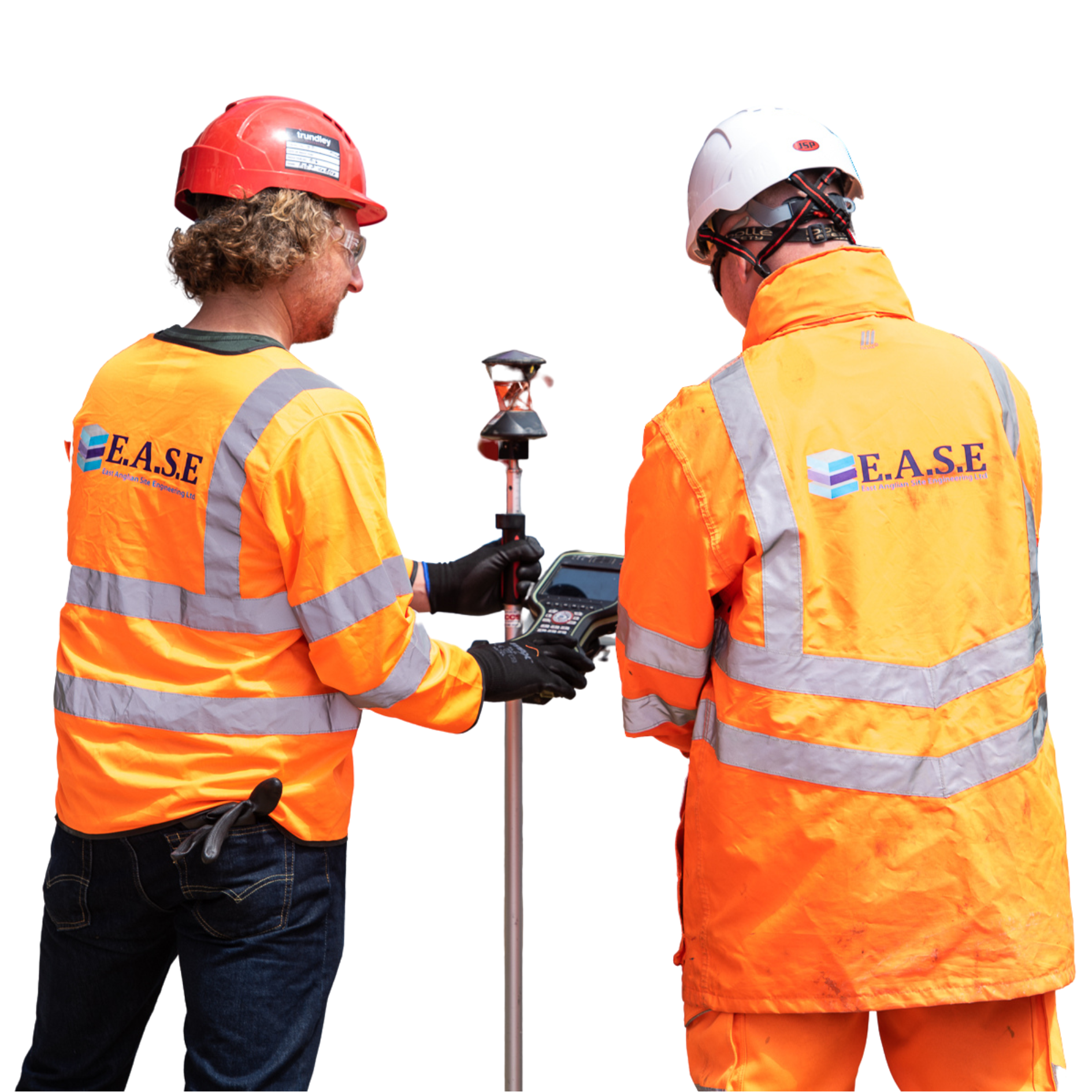
The most cost-effective point at which to address rework risk is before it arises. Accurate setting out ensures structures are positioned correctly from the start. Rigorous quality checks, including the management of inspection test plans (ITPs) at every hold point, provides the evidence trail that work has been carried out to the standard the framework demands.
On a well-run scheme, these steps help to form a connected process that protects the principal contractor’s position at every stage.
At EASE, we operate as a professional services company, not an agency. That means we retain full responsibility and liability for everything our engineering team is contracted to deliver. We manage the full site engineering function as a single, accountable service from programme start through to handover. If something is wrong, it is our responsibility to resolve it.
Getting involved at the start of a programme is where we can add the most value. It gives us the understanding of the site and the scheme that makes proactive quality management possible, and it is the most straightforward way to protect programme, cost, and delivery as work progresses.
If you’d like to discuss our offered services further, don’t hesitate to get in touch. Call us on 01603 211808 to speak with one of our friendly experienced team, or use our simple online form to place an enquiry.